

Table of Content
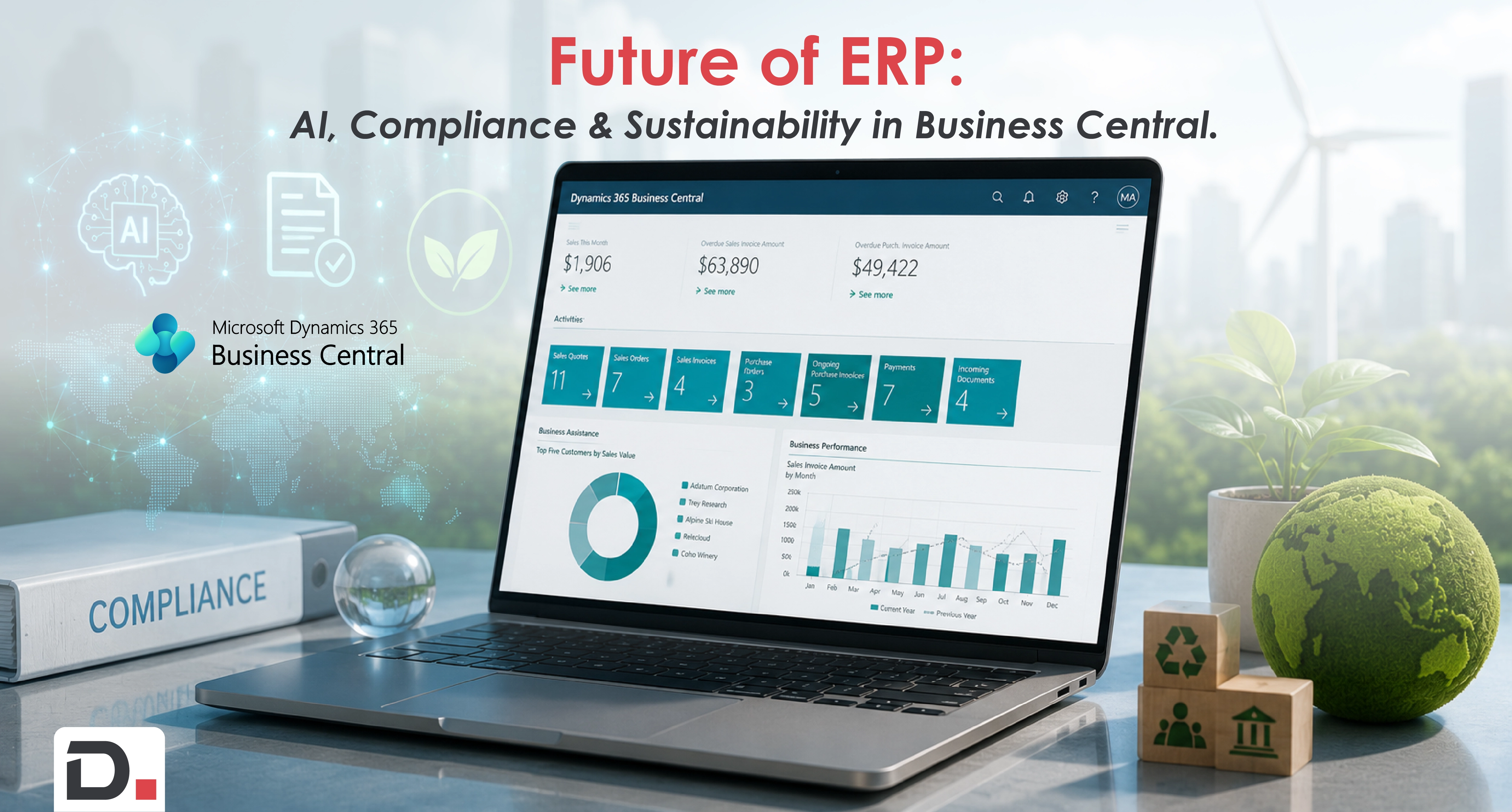
The future of ERP is not just about finance control , or plain operational tracking anymore. Nowadays, companies seem to want ERP to be more “smart”, more adaptable, more compliant, and also sustainability centered. And with regulatory pressure keep rising, customer expectations shifting, supply chains getting more tangled and then all the extra ESG priorities showing up, orgs are getting pushed toward digital solutions that feel faster and more connected.
To handle this shift, many businesses are moving past the older ERP model. Instead they’re leaning into modern cloud platforms, those that mix AI, automation, analytics, compliance management, and sustainability tracking, all inside one ecosystem that kind of links everything together.
Microsoft Dynamics 365 Business Central is starting to look like a future-ready ERP platform for small and mid sized businesses. You can see it in how AI driven automation helps, predictive insights guide actions, and day to day operations get smoother. Plus, there’s support for ESG reporting which makes the whole compliance side less painful, you know?
In this blog we’ll dig into what’s coming next for ERP, why AI is playing a bigger part now, how compliance and sustainability end up mattering a lot, and the main Dynamics 365 Business Central future trends that are shaping modern businesses.
What Happens If You Ignore This ?
Companies still leaning on outdated ERP setups often get stuck when compliance rules keep tightening, plus manual workflows turn into this slow grind, and data visibility gets blurry. On top of that, there is more pressure around sustainability goals. If you don’t introduce AI-powered automation and modern analytics, you’re more likely to see decisions happen slower, day to day operations stay inefficient, and it becomes much harder to pivot when the future business needs start coming in fast.
Checklist: Is Your ERP actually Future-Ready?
AI driven automation abilities
Cloud based access and safety
Real time reporting, insights and analytics
Compliance, audit support too
Workflow automation, smooth operations
ESG and sustainability reporting built in
Scalable integrations with Microsoft tools
Predictive forecasting, plus intelligent foresight
The Evolution of ERP Systems
Back then traditional ERP systems were made mostly to keep all business data in one place and smooth out daily operations. They did a pretty good job at helping organizations run their finance, inventory, purchasing, sales, manufacturing, and even customer info, all in the same area.
But lately, the business world has kind of shifted, a lot, like really, over the last decade.
Now most businesses expect things like:
Real time insights
Smart automation
Predictive analytics
Access from the cloud
Help with regulatory compliance management
ESG and sustainability reporting
Built in AI abilities
A setup that can scale and stay flexible
And legacy ERP systems often end up bumping into issues here, because they were designed around fixed operational routines, not around the more fluid data driven kind of business environment.
AI Is kind of Redefining The Future of ERP
Artificial Intelligence is becoming one of the biggest drivers behind ERP innovation, and honestly it is showing up everywhere faster than expected.
Most businesses don’t really want systems that just store data. They want ERP platforms that can analyze information, spot patterns, automate repetitive jobs, and help with smarter decision-making.
Going forward, the future of ERP will depend heavily on AI powered capabilities, because they improve operational efficiency while also cutting down on manual effort and extra work.
AI-Powered Automation in Business Central
Microsoft keeps folding AI capabilities into Business Central, mostly through Microsoft Copilot and those intelligent automation tools that feel both practical and well, seamless.
Some key AI-driven capabilities include:
Automated Financial Processes:
AI can handle repetitive accounting tasks like
Invoice matching,
Payment reconciliation,
Expense categorization,
Cash flow forecasting,
and Bank reconciliation
This lowers human errors, and it also improves financial accuracy while making processes more efficient.
Intelligent Demand Forecasting:
Business Central uses historical data and predictive analytics to forecast demand patterns more accurately.
That supports businesses by:
Reducing overstocking,
Preventing stock shortages,
Improving inventory planning,
Optimizing procurement decisions,
Strengthening supply chain management,
AI-Assisted Reporting:
Instead of users building reports manually, people can use AI generated summaries and insights.
So leadership teams can make faster calls using real time business intelligence, without waiting around for spreadsheets and updates.
Customer and Sales Intelligence:
AI can help companies understand buying behavior, uncover sales opportunities, and upgrade customer engagement.
Organisations can also use predictive insights to:
Improve customer retention,
Personalize interactions,
Increase sales conversions,
and Identify revenue opportunities
The future of ERP will lean more toward proactive business management, not just reactive reporting, even if the old habits still try to stick around.
Compliance Is Turning Into a Main ERP Expectation
Regulatory compliance is getting more complex, for companies that run across different regions and industries like a moving target that never really stops.
Most organizations now must stay on top of lots of things, for example tax requirements, financial disclosure standards, and privacy data laws. Besides that there are also industry specific rules, plus the environmental reporting expectations, and even the rules for supply chain conformity.
If compliance isn’t handled properly, the consequences show up as financial penalties, or legal threats, and sure, reputation issues. Sometimes you also see operational disruptions, because processes don’t match what the regulators want.
Since the rules are evolving quickly, businesses need ERP platforms that can adjust fast and follow along without a big lag.
Business Central AI Compliance Capabilities
Microsoft Dynamics 365 Business Central has a bunch of compliance related capabilities that kind of help companies lower exposure and keep regulatory expectations in check.
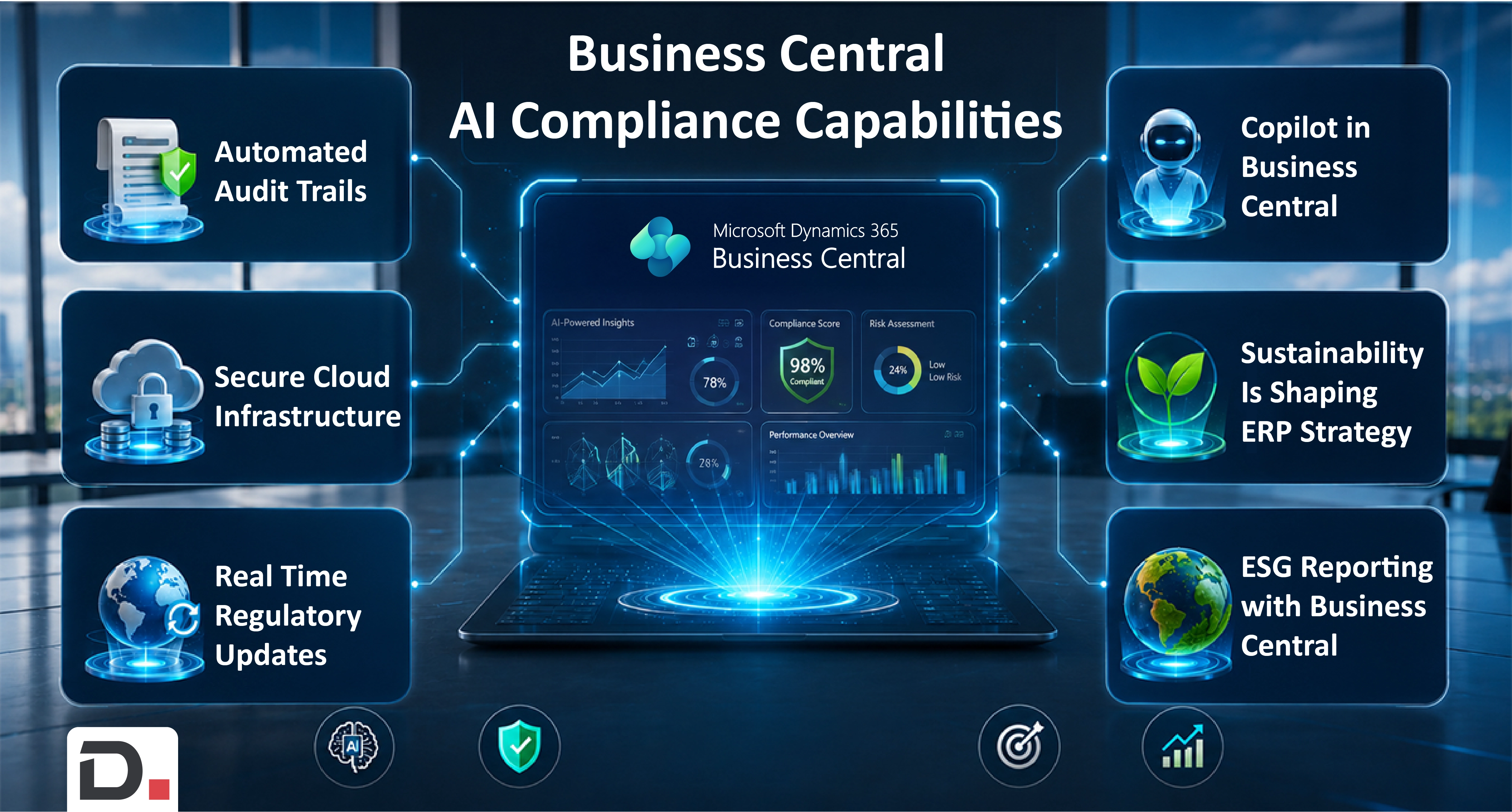
Automated Audit Trails
Business Central keeps really detailed transaction records , plus activity logs, which brings more transparency and makes audits way less painful.
So it lets organisations to-
Track user activities
Keep financial accountability
Sharpen internal controls
Support compliance documentation
Secure Cloud Infrastructure
Microsofts cloud setup comes with enterprise level protection features like:
Data encryption
Role based access controls
Multi factor authentication
Continuous security monitoring
Disaster recovery capabilities
Real Time Regulatory Updates
Cloud ERP systems often adjust quicker to shifting regulations than older on premise setups.
Also Microsoft typically rolls out updates for Business Central to keep up with changing compliance needs, so businesses can stay aligned with local and global expectations.
Copilot in Business Central
Copilot inside Business Central, sort of like a quiet helper right where you work, in Microsoft Dynamics 365 Business Central, delivers AI support that fits into the daily grind. It can nudge people to handle routine activities, and yes also help craft summaries, pull out insights, and generate reports quicker, all by using natural language prompts. In other words it helps with productivity more smoothly, and supports better choices by turning day to day data into something easier to grasp.
Sustainability Is Shaping ERP Strategy
Sustainability is shaping ERP strategy, like it’s always been there but now it’s suddenly everywhere. It’s not just some corporate initiative anymore. It feels more like a business must-have.
Customers, investors, governments, and other stakeholders are really expecting companies to show environmental responsibility and do transparent sustainability practices. And that expectation is pushing up the need for sustainable ERP solutions, the kind that lets businesses monitor environmental impact, improve how resources are used, and back ESG reporting without too much chaos.
Why ESG reporting matters, though
ESG stands for :
Environmental
Social
Governance
More and more businesses are being asked to measure, and then disclose things like
Carbon emissions
Energy consumption
Waste management
Supply chain sustainability
Employee wellbeing metrics
Ethical governance practices
Still, many organisations run into trouble because sustainability data is spread out across disconnected systems. It’s like everyone has a piece of the story, but nobody can see the full page.
Modern ERP platforms help fix this by pulling ESG-related information into core operational workflows, so the data is centralized and easier to manage.
ESG Reporting with Business Central
Microsoft is putting a lot of effort into sustainability centric technologies across its business applications ecosystem, kind of everywhere.
With ESG reporting using Business Central, organisations can merge sustainability tracking into their day to day operations, more or less.
Business Central provides the operational data foundation for ESG and sustainability initiatives. When integrated with Microsoft’s analytics and sustainability ecosystem, businesses can build advanced ESG reporting, sustainability dashboards, and environmental performance tracking capabilities.
Mini Use Cases
Manufacturing
AI forecasting in Microsoft Dynamics 365 Business Central helps manufacturers cut down raw material waste and improve production planning a bit better, you know, with more reliable timing.
Distribution
Organisations can tune inventory levels and simplify procurement with smart supply chain insights more or less.
Finance
Automated reconciliations and AI- powered reporting boost financial accuracy, and they also reduce the manual workload that people would otherwise have to handle themselves.
Before vs After Scenario
| Before Modern ERP | After Business Central |
| Manual reporting | Real-time dashboards |
| Spreadsheet-based planning | AI-powered forecasting |
| Disconnected systems | Unified cloud platform |
| Paper-heavy approvals | Automated digital workflows |
| Limited sustainability visibility | Centralized ESG data foundation |
Dynamics 365 Business Central Future Trends
Hyperautomation
Industry-Specific ERP Solutions
Real-Time Analytics and Decision Intelligence
Cloud-First ERP Adoption
AI Copilot Experiences
Why are businesses investing in future-ready ERP platforms?
Lately, businesses aren’t only judging ERP systems by their accounting capabilities, or at least not in the same way as before. Instead, they’re looking for that kind of platform that can really carry a few things together, like:
Business agility
Compliance readiness
Sustainability goals
AI innovation
Operational resilience
Digital transformation
Recommended next steps
Assess current ERP limitations, look at what’s really blocking you.
Identify automation and compliance gaps, not just the obvious ones.
Explore AI and sustainability requirements, and see where it’s a bit stubborn.
Evaluate Microsoft Business Central capabilities, to confirm if it can actually fit your process.
Consult ERP experts for a future-ready transformation roadmap, then pressure test it together.
Conclusion
The future of ERP is getting pulled forward by AI, automation, compliance, and sustainability, mostly. Microsoft Dynamics 365 Business Central helps organizations modernize day to day operations with intelligent insights, smoother workflows, and cloud capabilities that actually scale. It also supports long term growth plus those evolving ESG objectives, even when the roadmap changes.
As companies gear up for the next phase of digital transformation, putting money into a future ready ERP platform can lead to stronger operational efficiency, more informed decisions, and better business resilience, in general.
If you’re looking to refresh your ERP direction with AI driven and sustainable business solutions. Connect with Dynamics Square to see how Business Central can help your growth, compliance, and transformation aims.


Need The Best Dynamics 365 Implementation Partner?
Connect with our 15 Years of experienced, trusted and Australia-backed localised experts for seamless Dynamics 365 solution implementation. We help you adapt faster, work smarter and perform better, with full transparency.
Disclaimer– “All data and information provided on this blog is for informational purposes only. Dynamics Square / MPG Business Information Systems Pvt. Ltd. makes no representations as to accuracy, completeness, currentness, suitability, or validity of any information on this site and will not be liable for any errors, omissions, or delays in this information or any losses, injuries, or damages arising from its display or use.”


Related Posts & Blogs
Contemporary businesses are changing at a rate of knots using innovative business solutions to stay afloat. Know more about industry trends, challenges and opportunities in detail after going through an array of exciting blogs.
Read the blogs penned by industry-experts who know the nerve of the business to start your digital transformation journey.

ERP Requirement Checklist talks about the considerations while choosing a business management system for your ...

.webp)
A lot of businesses are still using legacy ERP systems, but is it time for an upgrade? Modern ERP systems offe...

Learn how ERP systems revolutionize supply chain management. Delve into benefits and best practices in our lat...

Find the best ERP for your nonprofit organisation with our top 10 list. It is high time to optimise your resou...