

Table of Content
For Australian food manufacturers, growth means managing greater complexity across ingredients, production, inventory, traceability, quality & fulfilment. Modern ERP brings these processes together, giving manufacturers the visibility and control to scale efficiently.
That is where technology needs to do more than record transactions. It needs to help manufacturers manage the growing complexity behind every production decision. For example:
- More products usually mean more ingredients.
- More production runs mean more batches to babysit.
- More customers mean tighter delivery windows.
- More suppliers mean more changing variability in costs and quality.
- And more volume means that even a small process gap can quickly turn into a costly operational headache.
A spreadsheet maybe was enough when the business was smaller but once production, inventory, purchasing, warehousing, finance and sales start working in separate systems, visibility gets split up, fragmented and the margins can disappear right between those gaps.
That’s where Business Central for Food Manufacturers Australia can make a noticeable difference.
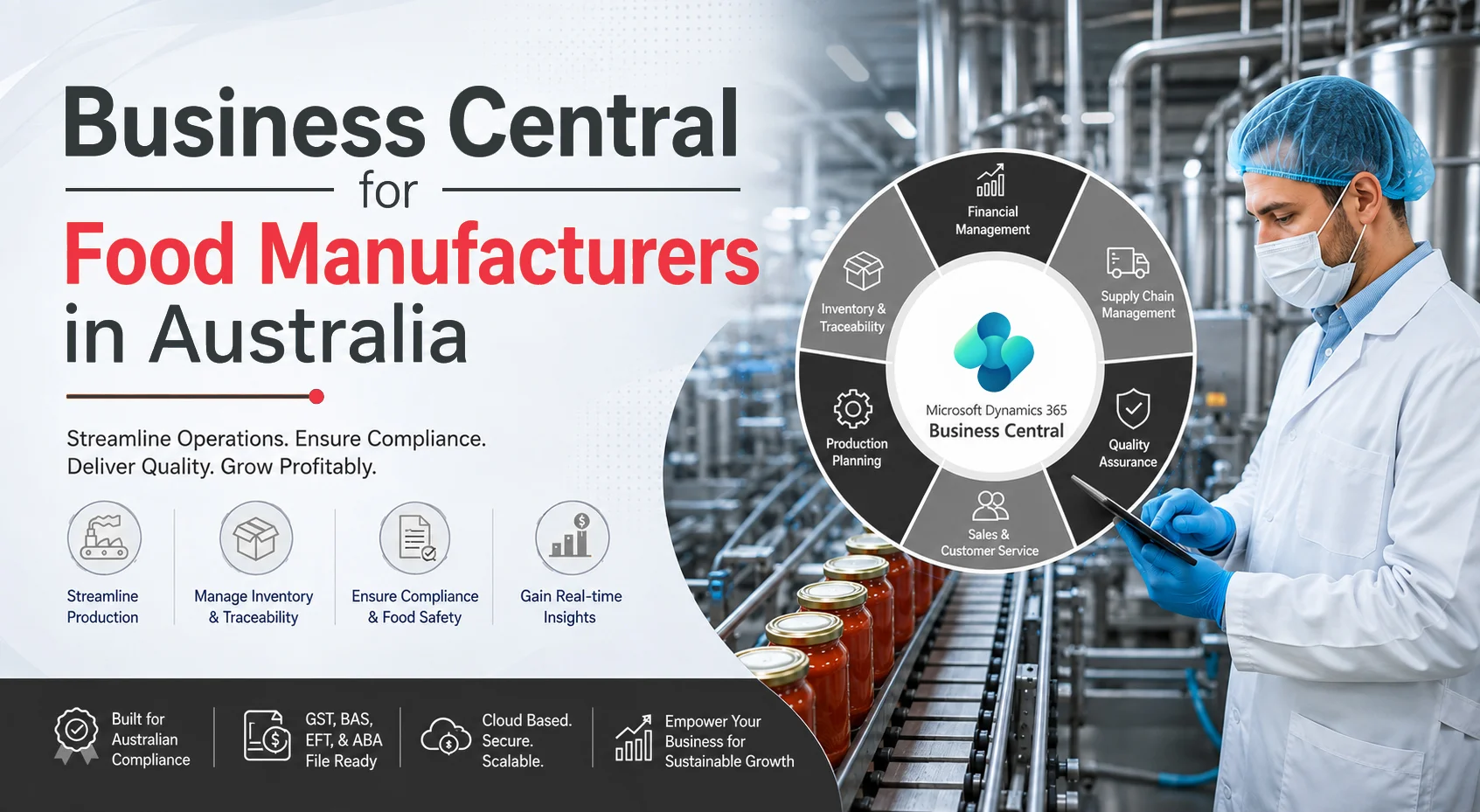
For Australian food manufacturers, Business Central can help link manufacturing, supply planning, inventory, warehouse operations, purchasing, sales and finance in one business management platform. Its manufacturing features support production of BOMs, routings, work centres, machine centres, capacity planning and production orders too.
At Dynamics Square, we don’t just stop at implementing Business Central; we go further with a repeatable food manufacturing implementation approach built around the processes, controls, data, and operational decisions that matter most to manufacturers.
Keep Reading ! Free Whitepaper Inside
Key Food Manufacturing Challenges Solved by ERP
Food manufacturing is more than just production. You’re dealing with ingredients, recipe logic, batches, shelf life, yields, waste, expense, overall quality, traceability and time tight distribution.
Three Questions Every Food Manufacturer Should Ask
1. Do we know what stock we have, not just what we think we have?
Inventory in food manufacturing extends beyond finished goods. It includes raw materials, packaging, work in progress, and finished products across multiple locations, often with batch and expiry-date requirements. Business Central connects inventory with purchasing, production, sales, and warehouse operations, giving manufacturers greater visibility and control over what is available, where it is located, and what requires attention.
2. Which batch went out to which customer, and how fast can we prove it?
When an ingredient has an issue, manufacturers need to pinpoint what products are impacted, which batches are involved, and which customers have received them. Business Central enables lot and serial tracking plus item tracing, so transactions can be traced forwards and backwards, from receipt and production to transfer and eventual sale.
3. Are we producing the exact thing customers expect, right at the right time?
Are we doing the exact thing customers expect, right when they need it, and not just close? With seasonal demand, promo calendars, ingredient scarcity, capacity limits, and short shelf lives, it turns planning into a confusion.
Business Central factors in demand and supply to recommend production steps, purchasing needs, assembly actions and transfers.
Instead of asking “What should we make next?”, teams can drift toward a more controlled, easier to govern question like:
“What should we manufacture, when should we do it, and what ingredients, tools, or materials do we need to manufacture it?”
Where Business Central Fits into Food Manufacturing ERP Australia?
Think of Business Central as the operational backbone that stitches the flow together.
Demand → planning → procurement → ingredients → production → quality and traceability → warehouse → distribution → finance.
In the manufacturing side, Business Central leans on production of BOMs to lay out what goes into a product, and routings to explain how it gets made in the first place. Not only that, production orders end up bringing all these bits together in one place ingredients and components, production quantities, operations, work centres, machine centres, capacity requirements, and production timing.
Microsoft frames production orders as central for planning, controlling, and tracking manufacturing activity.
For a food manufacturer, that gives you a far firmer base for managing those repeatable production routines.
The Food Manufacturing Capabilities That Matter: Dynamics 365 Business Central for Food Industry
Recipe and BOM Control
Rather than living with those disconnected recipe papers and spreadsheets, manufacturers can actually build their production BOMs so they reflect the materials needed to make the final items, in a way that feels more like one system than “several documents in different places”.
That gives a controlled link between:
Finished Product → Ingredients → Quantities → Production
and it builds a base for more precise material planning plus product costing too.
Production Planning
Business Central can help manufacturers line up demand with what supply can really support and what production requires.
Instead of bouncing around and manually checking a few different systems, planners can work from a connected planning setup.
Batch & Lot Traceability
For food businesses, traceability is not some “optional, nice to have” add-on. It’s core.
Business Central’s item tracking supports lot and serial number tracking, and Item Tracing can show exactly where a specific lot has moved across the company.
So, when a quality problem pops up, or a supplier issue gets flagged, investigation tends to be faster, and usually more direct.
Expiry Management
Shelf life can make or break margins.
If inventory just sits, it can turn into something like:
Stock → ageing stock → discounted stock → waste
Business Central adds expiry-related visibility, including its Item Expiration - Quantity report.
Warehouse Visibility
When production, inventory, and warehouse work from the same underlying data, warehouse teams can operate off a steadier view of what was received, produced, allocated and shipped.
For food manufacturers this can support better stock rotation, plus more controlled batch movement overall.
Manufacturing Cost Visibility
The cost of a finished item isn’t only “the ingredient price”.
- Raw materials
- Packaging
- Labour
- Machine time
- Production overheads
- Waste and scrap
- Subcontracting
- Production variances
Business Central connects manufacturing activity with costing and the financial side of the business, so leadership has a stronger basis for understanding product economics and production reality.
Business Central Isn’t Really the Destination. Better Manufacturing Is.
For Food and Beverage Manufacturers, the ERP conversation shouldn’t begin with the technology itself.
“Which features do we need?”
Honestly, it should start with, “Where are we losing visibility time margin and control today?”
From there Business Central becomes the technology foundation that helps untangle these challenges from ingredient purchasing and production planning to batch traceability, expiry management, warehouse operations, and customer fulfilment, while connecting production costs with management insights to provide a complete view of the business.
The real opportunity is bigger than swapping spreadsheets, or replacing an ageing ERP.
It’s about creating a more connected, traceable and commercially intelligent food manufacturing operation.
Plus, with Dynamics Square’s repeatable implementation IP and Microsoft Dynamics 365 know-how, Australian food manufacturers can look at Business Central as a business transformation.
Why Dynamics Square for Food Manufacturing ERP Australia?
At Dynamics Square, we have real expertise in Business Central transformation.
For food manufacturers, our value is not just software configuration.
We bring together below aspects:
Business Central know-how
We understand what Business Central do across manufacturing, inventory, finance, warehouse operations, and supply planning. Not just the feature list, but how it behaves in day to day reality.
Manufacturing process insight
We understand how production actually works from planning and material consumption to capacity, quality, and shop-floor processes.
Repeatable IP
Our structured discovery, process mapping, solution patterns, and implementation approach help reduce that constant need to restart from square one every time a project begins.
Migration experience
For businesses shifting from legacy ERP setups, like NAV or other older systems, we treat the transformation as a business improvement effort.
Cloud transformation
We help organisations move toward a modern Business Central environment that can connect with the broader Microsoft ecosystem.
Post go-live thinking
Our work doesn’t just stop at going live. The aim is to build a platform that can keep growing as the manufacturer adds products, customers, facilities, warehouses and operational complexity.
Our Repeatable Food Manufacturing IP
Instead of jumping into each new engagement from a blank page, we lean on a repeatable implementation framework that ties together proven process patterns, manufacturing know how and Business Central capability.
Our Food Manufacturing Blueprint:
| Layer | What We Examine |
|---|---|
| Product | Items, recipes/BOMs, variants, units of measure |
| Supply | Suppliers, lead times, purchasing and ingredient availability |
| Production | Routings, capacity, production orders, yields and waste |
| Traceability | Lots, batches, expiry and forward/backward traceability |
| Warehouse | Receiving, storage, picking, stock movement and dispatch |
| Commercial | Sales orders, pricing, customer fulfilment and margins |
| Finance | Costing, inventory valuation, profitability and reporting |
Business Outcomes: What Should Really Be Improving?
| Operational Challenge | Potential Business Outcome |
|---|---|
| Fragmented production data | One connected manufacturing view |
| Manual production planning | More structured demand-driven planning |
| Poor batch visibility | Faster traceability and investigation |
| Expiring inventory | Better visibility of ageing and expiry risk |
| Unclear production costs | Stronger product and production cost visibility |
| Excessive spreadsheet dependency | More controlled operational processes |
| Disconnected warehouse data | Better inventory and fulfilment visibility |
| Slow management reporting | Faster access to operational and financial insights |
| Difficult recall investigations | More structured forward/backward traceability |
| Growth constrained by manual processes | A scalable operational platform |
Practical F&B Industry Example
Consider an Australian food manufacturer moving packaged meals to supermarkets in NSW and Victoria. When a supplier identifies an issue with a specific ingredient lot, the business can use Business Central to quickly identify affected batches and customers.
Customer Success Story: Fresh Produce ERP Modernization
One leading fresh produce trading company migrated from Microsoft Dynamics NAV to Dynamics 365 Business Central Cloud.
Outcomes Measured
| Outcomes | Measurable Business Impact |
|---|---|
| Inventory accuracy | 75% |
| Order processing time | 20% fast |
| User training time | 30–40% low |
| Compliance risk | 80%+ low |
| Remote task completion | 40% |
| Reporting | Real-time visibility |
But Here’s Where Implementation Expertise Really Matters
Having Business Central is not the same as having a Business Central environment designed properly for food manufacturing.
Item → BOM → Production Order → Invoice
But a food manufacturer has to think further like:
Ingredient → Supplier Lot → Quality Release → Production Batch → Yield → Finished Lot → Expiry Date → Warehouse Storage → Customer Handoff → Recall
Free Whitepaper Alert
Download here: Overcoming Food & Beverage Challenges with Dynamics 365 | Whitepaper
Conclusion
As ERP for Food and Beverage Manufacturers, Dynamics 365 Business Central can link production, inventory traceability, warehousing, purchasing, plus finance into one shared platform.
Ready to modernise your food manufacturing operations? Connect with Dynamics Square and see how Business Central can support your next stage of growth.
.webp)

Business Central Implementation
Make the most of Dynamics 365 Business Central with the help of Dynamics Square team.
Disclaimer– “All data and information provided on this blog is for informational purposes only. Dynamics Square / MPG Business Information Systems Pvt. Ltd. makes no representations as to accuracy, completeness, currentness, suitability, or validity of any information on this site and will not be liable for any errors, omissions, or delays in this information or any losses, injuries, or damages arising from its display or use.”


Related Posts & Blogs
Contemporary businesses are changing at a rate of knots using innovative business solutions to stay afloat. Know more about industry trends, challenges and opportunities in detail after going through an array of exciting blogs.
Read the blogs penned by industry-experts who know the nerve of the business to start your digital transformation journey.

Do you want to achieve more in your business? Read more to know how dynamics 365 can make a difference in scal...


Read this Blog Post to Learn about ERP Systems for Food Manufacturers....

Looking for a business productivity boost? Check out Microsoft Dynamics 365 Business Central. This cloud-based...

Microsoft Business Central is a powerful tool that can help businesses streamline their operations. However, i...