

Table of Content
Businesses create an enormous amount of data through sales, finance, inventory, warehousing, and day-to-day operations. However, the real challenge is no longer collecting information, but transforming it into practical insights that support faster and smarter decision-making.
Many organisations still struggle with fragmented reporting tools, spreadsheet-heavy processes, and inconsistent data quality across departments. As reporting requirements continue to grow, traditional reporting methods often become difficult to manage and scale.
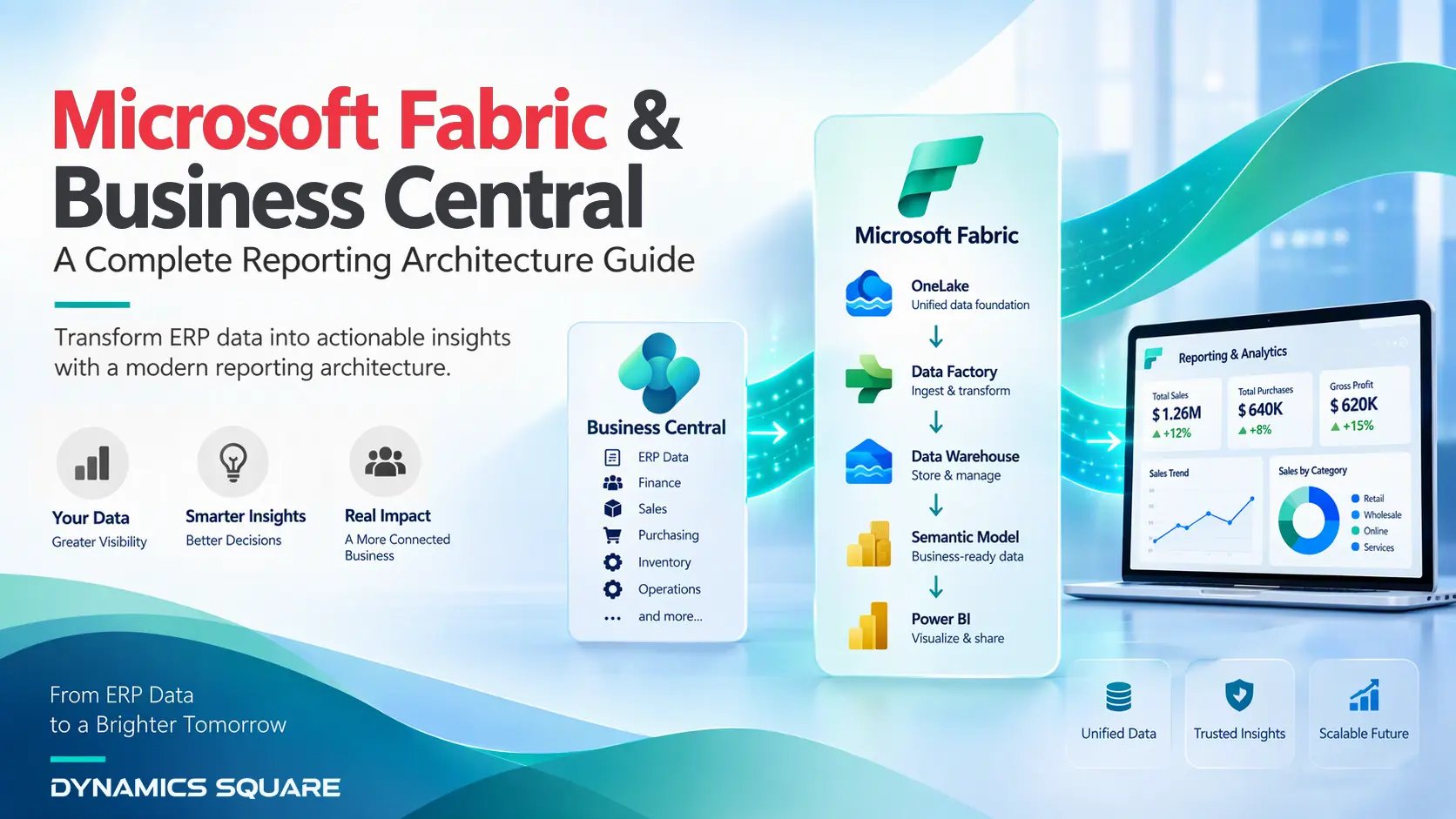
This is where Microsoft Fabric and Dynamics 365 Business Central work together. Microsoft Fabric is a unified analytics platform that combines data integration, data engineering, data warehousing, real-time analytics, and business intelligence in a single environment powered by OneLake.
When integrated with Business Central, Microsoft Fabric enables a modern ERP reporting architecture that delivers real-time visibility, unified analytics, scalable reporting, and AI-ready intelligence. This guide explores how Microsoft Fabric is transforming Business Central reporting and enabling organisations to make more informed, data-driven decisions.
Why Traditional ERP Reporting Is No Longer Enough
Most ERP systems were initially designed to process business transactions efficiently and reliably. While Dynamics 365 Business Central includes robust reporting capabilities, modern organisations require more than standard reports and dashboards.
Today's businesses increasingly demand:
- Real-time reporting
- Cross-functional analytics
- Enterprise-wide visibility
- Self-service business intelligence
- Advanced analytics
- AI-driven insights
Traditional reporting environments often rely on multiple data sources, disconnected reporting tools, manual data extraction processes, and complex integrations. This frequently leads to delayed insights and limited scalability.
As businesses grow, reporting becomes increasingly complex. Instead of operating from a single source of truth, organisations often find themselves managing different versions of the same dataset across departments, creating inconsistencies and slowing decision-making.
Traditional Power BI Architecture vs Microsoft Fabric Architecture
| Aspect | Traditional Power BI Architecture | Microsoft Fabric Architecture |
|---|---|---|
| Data Storage | Separate | OneLake-based |
| Data Integration | Multiple integration components | Integrated data services |
| Governance | Fragmented | Centralised |
| Analytics | Tool-based | Unified |
| Data Engineering | Often managed through separate services | Fabric Data Engineering |
| BI Layer | Power BI | Power BI within the Fabric ecosystem |
| Tooling | Separate tools | Integrated platform |
| Data Architecture | Multiple technology layers | Integrated data and analytics platform |
| AI Readiness | Limited | Built-in |
| Scalability | Limited | Enterprise analytics |
What Is Microsoft Fabric?
Microsoft Fabric is Microsoft's unified data analytics platform that brings together analytics, business intelligence, and data management capabilities within a single ecosystem.
Fabric combines multiple technologies within a software-as-a-service (SaaS) environment, including:
- Data Engineering
- Data Factory
- Data Warehousing
- Real-Time Analytics
- Data Science
- Power BI
- Microsoft OneLake
Instead of managing separate technologies for reporting and analytics, organisations can use one connected platform that simplifies data management, reporting, and enterprise analytics.
This unified approach supports the creation of a modern Microsoft Data Platform that addresses both operational reporting and strategic analytics requirements.
Signs Your Business Needs Microsoft Fabric
The following signs indicate your organisation may benefit from Microsoft Fabric:
- Reporting delays across departments
- Data stored in disconnected systems
- Manual consolidation of ERP and reporting data
- Inconsistent KPIs between teams
- Power BI performance challenges
- Increasing demand for real-time analytics
- Difficulty preparing data for AI initiatives
- Heavy reliance on spreadsheets for reporting
Business Central Data in OneLake
OneLake serves as the foundational data layer within Microsoft Fabric, providing a unified and scalable analytics environment for Business Central data.
Instead of maintaining multiple copies of ERP data across separate reporting systems, organisations can centrally store, access, and govern Business Central information through a single logical data lake.
By consolidating finance, sales, inventory, warehousing, and operational data in OneLake, businesses establish a reliable source of truth for analytics, reporting, and AI-driven insights.
Key Benefits of OneLake
- Centralised Business Central data storage
- Reduced data silos and duplication
- Consistent reporting across departments
- Scalable analytics and lakehouse architecture
- Stronger governance and security controls
- Better support for Power BI, AI, and advanced analytics
As part of a modern ERP reporting architecture, OneLake helps organisations transform Business Central data into a strategic asset for both real-time decision-making and long-term business intelligence initiatives.
Where Does Microsoft Fabric Fit into Business Central Reporting?
Dynamics 365 Business Central serves as the operational engine for finance, inventory, purchasing, sales, warehousing, supply chains, and service operations.
However, organisations often need to combine ERP data with information from CRM systems, eCommerce platforms, manufacturing applications, Excel files, external databases, and third-party solutions.
Microsoft Fabric provides the reporting architecture that unifies these disparate data sources into a single analytics ecosystem.
This approach strengthens:
- Business Central analytics
- ERP data analytics
- Financial reporting
- Operational reporting
- Dashboard analytics
- Enterprise reporting solutions
Understanding the Modern Reporting Architecture
A modern Microsoft Fabric Business Central reporting architecture built on Microsoft Fabric has five connected layers:
Layer 1: Business Data Sources
Effective reporting begins with reliable business data from multiple operational systems. Common data sources include:
- Dynamics 365 Business Central
- CRM systems
- Supply chain applications
- Warehouse management solutions
- Manufacturing systems
- External business applications
Business Central often serves as the central ERP platform for operational and financial data.
Layer 2: Data Integration
Microsoft Fabric enables organisations to ingest, connect, and transform data from multiple sources within one environment.
Rather than developing complex point-to-point integrations, businesses can build streamlined data pipelines that improve consistency and reduce reporting challenges.
Layer 3: OneLake and the Data Lakehouse
At the centre of Microsoft Fabric is Microsoft OneLake, a unified logical data lake that enables centralised governance, security, lineage tracking, and data management.
The Lakehouse architecture provides:
- Unified analytics
- Reduced data duplication
- Improved governance
- Scalable reporting architecture
- Enhanced security controls
- Consistent reporting standards
Layer 4: Analytics and Data Processing
Once data enters Microsoft Fabric, organisations can transform raw data into actionable intelligence.
Fabric supports:
- Data cleansing
- Data transformation
- Analytical modelling
- Forecasting scenarios
- KPI development
- Advanced analytics
This enables organisations to move beyond historical reporting and begin supporting predictive and forward-looking decision-making.
Layer 5: Power BI Reporting and Visualisation
Power BI dashboards and reports deliver insights to business users across the organisation.
Examples include:
- Executive dashboards
- Financial reports
- Operations dashboards
- Inventory analytics
- Supply chain reporting
- Sales performance tracking
- Real-time dashboards
This approach enables self-service business intelligence while maintaining governance and consistency across the organisation.
How Microsoft Fabric Improves Business Central Reporting
Organisations that adopt Microsoft Fabric alongside Dynamics 365 Business Central often experience significant improvements in reporting, analytics, and decision-making capabilities. By bringing data together in a unified platform, businesses can move beyond disconnected reporting processes and gain greater visibility across operations.
1:Single Source of Truth
Microsoft Fabric centralises business data from multiple systems into a unified environment. This ensures all departments work from consistent and accurate information, improving trust in reporting and reducing conflicting data interpretations.
2:Real-Time Reporting
Traditional reporting often relies on scheduled refreshes and manual data preparation. Fabric enables near real-time visibility into business performance, allowing decision-makers to respond faster to operational changes and emerging opportunities.
3:Enterprise-Scale Analytics
As data volumes increase, reporting requirements become more demanding. Microsoft Fabric provides a scalable analytics platform capable of supporting enterprise-level workloads without compromising performance.
4:Connected Reporting Across Departments
By integrating operational, financial, customer, and supply chain data, organisations can create comprehensive reports that span multiple business functions and provide broader business visibility.
Real-World Example
Unified Analytics Platform Consolidation
Many Australian organisations operate multiple analytics and reporting tools simultaneously, including separate solutions for data integration, data warehousing, business intelligence, and data science. Maintaining these systems often increases licensing costs, integration complexity, and administrative effort.
How Microsoft Fabric solves this challenge:
Microsoft Fabric consolidates these capabilities into a single environment. Data engineers, analysts, business users, and data scientists can work from the same platform while sharing a common data foundation. Governance policies and security controls remain consistent across the organisation.
Example: A mid-sized pharmaceutical company could replace several disconnected analytics platforms with Microsoft Fabric, reducing infrastructure complexity while significantly improving time-to-insight for business reporting.
Industry Use Cases for Microsoft Fabric
Manufacturing
Manufacturers frequently manage data across multiple systems, including production, inventory, supply chain, and ERP platforms.
Common data sources include:
- Production systems
- Inventory platforms
- Supply chain tools
- ERP systems
With Microsoft Fabric, manufacturers can gain:
- Real-time production analytics
- Greater inventory visibility
- Predictive maintenance insights
- Operational KPI monitoring
Finance
Finance teams often struggle with time-consuming manual reporting processes and spreadsheet dependency.
Microsoft Fabric helps reduce:
- Manual reporting effort
- Spreadsheet reliance
- Month-end reporting delays
At the same time, it supports:
- Real-time financial analytics
- Unified reporting environments
- Governance and compliance initiatives
- Improved forecasting capabilities
Logistics and Supply Chain
Supply chain and logistics organisations depend on accurate, timely operational insights.
Microsoft Fabric helps deliver:
- Shipment visibility
- Warehouse analytics
- Route optimisation intelligence
- Operational performance dashboards
Why Microsoft Fabric Matters for AI-Driven ERP Analytics
Artificial intelligence initiatives rely heavily on connected, high-quality, and well-governed data. Without a unified data platform, organisations often struggle to deliver successful AI outcomes because critical information remains scattered across multiple systems.
Microsoft Fabric creates a foundation for:
- Advanced analytics
- Data-driven decision-making
- AI readiness
- Predictive insights
- Future analytics initiatives
For organisations planning long-term investments in AI and Microsoft technologies, Fabric serves as the bridge between transactional ERP systems and intelligent business applications.
Why Business Central Customers Are Starting to Adopt Microsoft Fabric
For organisations already using Dynamics 365 Business Central, Microsoft Fabric extends existing reporting capabilities into a modern analytics ecosystem.
Key benefits include:
- Native Power BI integration
- Unified data analytics capabilities
- Enterprise governance and security
- AI-ready architecture
- Cloud-based scalability
- Centralised enterprise reporting
Recent Microsoft developments, including Business Central data mirroring into OneLake, continue to expand reporting and analytics possibilities beyond traditional ERP reporting boundaries.
Industry Trends Driving Microsoft Fabric Adoption
Several market trends are accelerating demand for unified analytics platforms.
1.AI-Enabled Decision-Making
Businesses are increasingly investing in AI technologies, Copilot experiences, and intelligent automation. These initiatives require centralised, high-quality data foundations.
2.Near Real-Time Intelligence
Modern organisations expect operational visibility as events occur rather than depending exclusively on periodic reporting cycles.
3.One Connected Data Ecosystem
Many businesses are moving away from fragmented reporting environments and adopting centralised enterprise data platforms that support organisation-wide analytics.
4.Cloud Analytics Adoption
Cloud-native analytics platforms provide the scalability and flexibility required to support rapidly changing business requirements.
Decision-Maker Insights
For CIOs and CTOs:
Fabric helps create a more streamlined analytics architecture and it also strengthens governance in a practical way.
For CFOs
With a unified analytics platform, financial visibility becomes stronger. It also supports improved forecasting accuracy.
For COOs
Real-time operational intelligence enables faster decision-making and more informed choices.
For Data Teams
Fabric reduces overall complexity by bringing several analytics workloads into one platform. As a result, there’s less friction and more clarity across the board.
Future of Microsoft Fabric and Business Central
Microsoft continues to strengthen the integration between Dynamics 365 Business Central and Microsoft Fabric.
With Business Central data replication and mirroring capabilities within OneLake, organisations can unlock broader analytics scenarios and enhance the value of their Power BI reporting investments.
This aligns with Microsoft's broader vision of creating a unified ecosystem that connects ERP, business intelligence, advanced analytics, and artificial intelligence within a single data strategy.
Conclusion
Modern reporting is no longer limited to generating dashboards and static reports. Today's organisations require reporting architectures that unify business data, scale with growth, provide real-time visibility, and support future AI-driven innovation.
By combining Dynamics 365 Business Central, Microsoft Fabric, OneLake, and Power BI, organisations can build a modern enterprise reporting architecture that transforms ERP data into actionable business intelligence.
The result is a connected ecosystem that supports Business Central reporting, ERP analytics, real-time dashboards, unified data analytics, and consistent data-driven decision-making across the organisation.
For organisations looking to modernise their reporting capabilities, Microsoft Fabric provides the foundation for a scalable, intelligent, and future-ready analytics platform.
Ready to Move Beyond Traditional BI?
Discover how Microsoft Fabric can help unify your business data, simplify analytics, and unlock AI-driven insights across your organisation.
Whether you're looking to modernise reporting, improve decision-making, or prepare your business for the future of analytics, our experts can help.
Talk to Dynamics Square today and explore how Microsoft Fabric can transform your Business Central reporting strategy.
Book a Free Consultation

Witness a Scalable Transformation
Experience real-time synchronisation and flexibility with a consistent view across your business.
Disclaimer– “All data and information provided on this blog is for informational purposes only. Dynamics Square / MPG Business Information Systems Pvt. Ltd. makes no representations as to accuracy, completeness, currentness, suitability, or validity of any information on this site and will not be liable for any errors, omissions, or delays in this information or any losses, injuries, or damages arising from its display or use.”


Related Posts & Blogs
Contemporary businesses are changing at a rate of knots using innovative business solutions to stay afloat. Know more about industry trends, challenges and opportunities in detail after going through an array of exciting blogs.
Read the blogs penned by industry-experts who know the nerve of the business to start your digital transformation journey.

Microsoft Fabric replaces traditional BI with real-time analytics, unified data, and AI-driven insights, helpi...

Microsoft Fabric is Microsoft’s unified data and analytics platform that integrates OneLake, Power BI, and a...
Learn how Microsoft Dynamics 365 Business Central helps mid-size businesses streamline finance, inventory, sal...

Dynamics 365 Business Central helps Australian food manufacturers improve production, inventory, traceability,...