

Table of Content
Managing finance across multiple legal entities is rarely as straightforward as keeping separate sets of accounts. As Australian organisations spread into new markets, pick up subsidiaries, set up regional operations or reorganise business units, the financial part gets more complex. Finance teams end up lining up transactions across entities, handle intercompany accounting, reconcile balances, keep controls consistent and then produce consolidated reports that give leadership a clear sense of how the business is performing.
For organisations that operate across Australia and beyond international markets, all this gives rise to business complexity. Different currencies, tax rules, accounting structures, reporting cycles and day-to-day operational processes, it turns consolidation into a time-consuming job to manage.
Microsoft Dynamics 365 Finance gives enterprise-level financial management features built to support complicated financial operations, multi-entity accounting, consolidation, reporting and financial governance.
An experienced Dynamics 365 Finance implementation partner should understand how multiple entities operate, how financial data flows across the organisation and how to set up repeatable processes without overlooking entity specific requirements.
This checklist walks through the critical capabilities, questions and considerations finance leaders should review first before making that decision.
Did You Know? Simplifying Multi-Entity Financial Consolidation
Microsoft Dynamics 365 Finance helps businesses pull together financial data across several legal entities even when they are using different charts of accounts and totally separate fiscal calendars and currencies too.
That way multinational organisations can simplify their group level reporting and get much more clear visibility into how the business is performing day-by-day.
Signs Your Multi-Entity Finance System Needs an Upgrade
As businesses expand across multiple entities, outdated finance systems can struggle to keep up with increasing operational complexity. Watch for these common warning signs:
- Manual financial consolidation
- Delayed reporting
- Reconciliation complexity
- Limited financial visibility
- Disconnected systems
- Weak financial controls
If this sounds familiar, it’s time to look at a modern ERP platform such as Microsoft Dynamics 365 Finance so you can streamline financial operations, boost reporting transparency and back multi-entity growth.
Why Multi-Entity Dynamics 365 Finance Implementations Need a Different Approach?
A single-entity ERP rollout usually centers on centralising financial operations, standardising processes and improving reporting inside one legal structure.
Each legal entity can have its own:
- Chart of accounts and financial dimensions
- Functional and reporting currencies
- Tax duties and statutory disclosure obligations
- Financial periods and accounting policies
- Banking setups and payment processes
- Intercompany dealings and reconciliation work
- Approval structures and financial controls
The real issue is to build a linked financial workspace while still keeping the autonomy each entity requires.
So, for instance, an Australian parent company might run subsidiaries in Singapore, the United Kingdom and the United States. Each subsidiary can be forced to follow different statutory rules, use different currencies and run different finance routines while the group still has to produce consolidated financial statements and keep management reporting in some consistent order.
Dynamics 365 Finance can handle multiple legal entities, intercompany accounting, currency translation and consolidation. Still, those features don’t just “work” on their own, they have to be configured to match the organisation’s actual financial setup.
That’s why an experienced implementation partner should understand not only what the system can do but also the financial mechanics behind it too.
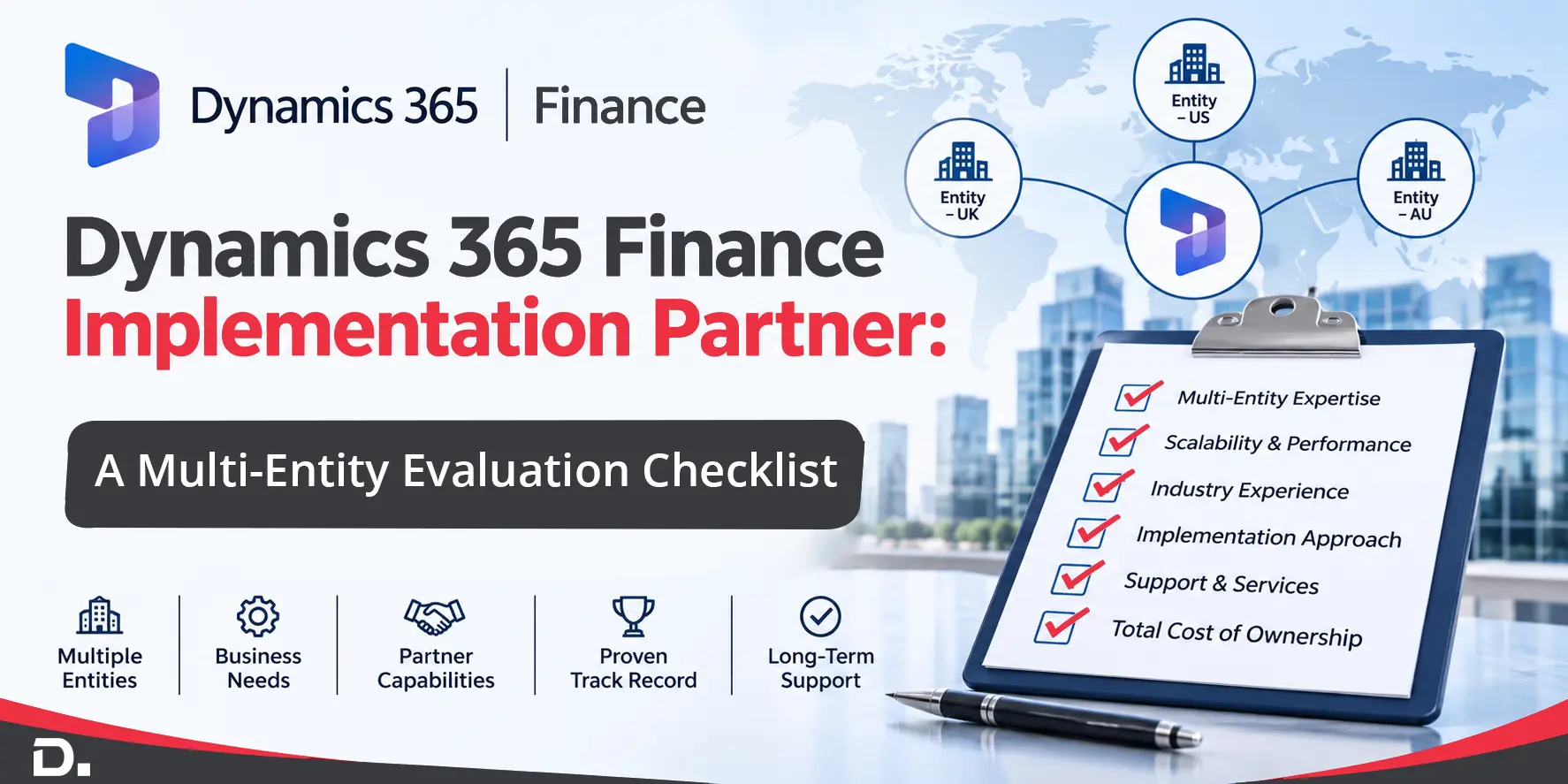
Dynamics 365 Finance Implementation Partner: The Multi-Entity Evaluation Checklist
Before you choose a finance consultancy or an implementation partner, it’s worth using a checklist that helps you look at their experience delivery style and how they support real complicated financial setups. Let’s explore below pointers:
1. Evaluate Their Experience with Multi-Entity Implementations
Not every Dynamics 365 Finance implementation partner has done the hard work of multi-entity, multi-country work. Doing ERP for one business is not the same as designing a financial platform for a group of subsidiaries, across borders, systems and local expectations that don’t line up.
Your partner should be able to help you: Set up a sensible legal entity structure, tune shared financial processes and handle the differences between subsidiaries.
What to evaluate:
- Previous experience implementing Dynamics 365 Finance across multiple legal entities.
- Experience with parent organisations, subsidiaries and regional business arrangements.
- Knowledge of multi-country financial operations.
- Experience managing, different currencies and accounting expectations in general.
- Ability to design centralised and decentralised finance processes.
- Experience supporting complex organisational structures, hierarchies included.
2. Assess Their Multi-Entity Migration and Data Management Capabilities
Data migration is one of those stages that quietly makes or breaks the whole project especially when several legal entities are present on different legacy systems.
An organisation might be moving from legacy ERP tools, spreadsheets, accounting applications or even different versions of finance systems.
The real job is making sure transactional and historical data stays accurate, consistent, and usable once it lands in the new environment. A capable partner should bring a structured migration plan covering areas like:
Existing chart of accounts and account mapping.
General ledger balances and opening balances.
Customer and vendor data.
Outstanding accounts payable and receivable items.
Historical transactions, and financial records.
Currency balances, exchange rate information as well.
Financial dimensions and reporting structures in one place.
Intercompany balances and outstanding transactions again.
3. Assess Their Financial Consolidation Capabilities
Financial consolidation can get complex when you run multiple subsidiaries. For finance leaders, there’s a need for a dependable way to merge financial information from separate legal entities even while currency differences show up, intercompany activity happens and the reporting structures change by region too.
That’s why your implementation partner should understand the consolidation approaches that are available in Dynamics 365 Finance and then they can suggest the right setup based on what you need not just what’s “standard”.
Some top aspects to look at:
- Consolidation across a couple of different legal entities.
- Currency translation.
- Intercompany elimination entries.
- Consolidated financial statements.
- Different charts of accounts.
- Different fiscal calendars.
- Multiple reporting currencies.
- Group-level financial reporting with traceability.
4. Review Their understanding of intercompany accounting
When multiple legal entities are running inside the same group, transactions between subsidiaries are almost unavoidable.
Like, an Australian parent company might buy services from its Singapore subsidiary while a UK entity supplies products to another group company.
Without some real intercompany accounting process, these things can bring reconciliation delays, balances that don’t match and yes mistakes during consolidation.
So, your Dynamics 365 Finance implementation partner should know how to set up intercompany accounting so cross-entity transactions work the way you expect.
What to evaluate:
- Intercompany journal entries.
- Intercompany customer and vendor relationships.
- Automated transaction creation and posting.
- Intercompany invoicing processes.
- Due-to and due-from account management.
- Reconcile those intercompany balances
- Elimination of the intercompany transactions
- Transaction tracking across legal entities
5. Evaluate Their approach to financial controls and compliance
As organisations grow, financial controls start mattering more.
If you have a group with several subsidiaries, you still need consistent financial governance, while each entity follows its own statutory and operational requirements, yep even the small differences matter.
Your implementation partner should know how to build controls inside Dynamics 365 Finance without turning approvals into a bottleneck.
Key areas to assess:
- Role based security and user permissions.
- Segregation of duties.
- Journal approval workflows.
- Payment authorisation controls.
- Vendor and customer master data controls.
- Audit trails and transaction history.
- Financial period management.
- Budget related controls.
- Tax configuration and reporting requirements.
- Entity specific approval hierarchies.
6. Check Their implementation governance and project management framework
Multi entity implementations usually involve multiple stakeholders, different business priorities, and dependencies across finance, IT, operations and leadership.
Without clear governance, projects can drift into scope changes, delayed decisions, inconsistent configurations and surprise implementation costs.
A decent Dynamics 365 Finance implementation partner should set up a governance framework before the project goes into configuration and deployment.
What to evaluate:
Defined project scope and deliverables.
Executive sponsorship, steering committees.
Testing and deployment approvals.
Go live readiness assessments and more.
7. Assess Their Approach to Standardisation Versus Localisation
One of the hardest parts in a multi-entity implementation is figuring out which processes should be made the same everywhere versus which ones should stay for each entity.
Like the organisation might want a shared chart of accounts, group-wide financial reporting and a consistent approval workflow across the whole set.
But then you get that reality check: Individual subsidiaries may need totally different tax setups, local banking arrangements, statutory reports or even payment processes.
So, your implementation partner should help you strike the right balance not just push a template and hope.
What to evaluate:
- Standardised group-level financial processes.
- Entity-specific statutory requirements.
- Shared vs separate charts of accounts.
- Common financial dimensions.
- Local currency and reporting needs.
- Country-specific tax configurations.
- Centralised versus decentralised approvals.
- Standard reporting templates.
8. Review Their Integration and Reporting Capabilities
Finance teams often use payroll, banking, procurement, expense management, CRM, tax reporting and business intelligence tools all at once.
Your implementation partner should understand how all those parts talk to Dynamics 365 Finance not just the Finance module itself.
What to evaluate:
- Integration with banking and payment platforms.
- Connections in procurement and operational systems.
- Payroll expense management integrations too.
- Data exchange between subsidiaries.
- Financial reporting, analytics and dashboards.
9. Understand Their Testing, Training and Change Management Strategy
Even if the tech side works, the whole aspect can still be complex if finance teams aren’t ready and confident to use the new system. Multi-entity projects need testing and training that reflect how different users, departments and subsidiaries actually operate.
Your implementation partner should give you a structured plan that covers system testing, user acceptance and organisational readiness not just slides.
What to evaluate:
- Unit and system integration testing.
- User acceptance testing (UAT).
- Intercompany transaction testing.
- Consolidation and reconciliation testing.
- Financial control.
10. Evaluate post-implementation support and long-term scalability of the whole system
Your relationship with a Dynamics 365 Finance implementation partner should not just end at go-live. There should be some continuity like check-ins and a plan for longer-term scaling. Financial requirements tend to shift when organisations grow, acquire companies, move into new markets or change operating models.
What to evaluate:
- Issue management and escalation procedures.
- System performance monitoring.
- Microsoft update management.
- Financial process optimisation.
- Integration maintenance.
- User support and knowledge transfer.
- Support for new legal entities.
- Long-term solution roadmap.
AI in Multi-Entity Financial Management
As we are well-aware that AI is becoming increasingly crucial in modern finance transformation, Aussie businesses tend to automate repetitive finance processes, improve forecasting and analyse financial data efficiently.
As Australian businesses manage financial work across several legal entities, AI is acting as a big deal in modern finance transformation. It can help finance teams take away some of the repetitive load, spot odd transaction patterns and pull meaning from financial data quicker sometimes way faster than expected.
AI-powered features can support few main areas such as:
- Automated Financial Processes
- Anomaly Detection
- Cash Flow Forecasting
- Faster Financial Analysis
- Improved Decision-Making
For those running operations across multiple subsidiaries, AI can work alongside connected financial data and standardised processes. Yet, any good insights still depends on dependable data, sensible controls and a well-designed ERP setup not just the model itself.
Overall, Microsoft Dynamics 365 Finance lets businesses explore AI-driven financial capability while also building a more connected, more efficient and future-ready finance function.
To explore how Microsoft is bringing AI into financial operations, read our detailed guide on Dynamics 365 Finance Agent: Features, Pricing and ROI, covering its key capabilities, practical use cases, licensing considerations and potential business benefits.
Read here: Dynamics 365 Finance Agent: Features, Pricing & ROI Guide
Red Flags to Watch for When You Are Selecting an Implementation Partner
Even if the partner tells you they already have Microsoft Dynamics 365 experience, there are still a couple of warning signs that should make you pause and verify more. It can look good at first glance but then later you realise there are gaps.
Below are the red flags to keep an eye on:
- Limited experience across multiple entities
- Overdependence on customisation
- Unclear project governance
- Limited financial process knowledge
- Weak post go-live planning
In general, a suitable partner should be able to explain more than “what we will configure”. They should also connect the dots on why their approach fits your organisation.
When evaluating a Dynamics 365 Finance implementation partner, Australian businesses must consider the proposed solution architecture, data model and financial controls in order to ensure their longer-term automation and AI-centric goals.
Final Thoughts: Choose a Partner Who Gets Your Financial Design
Choosing a Dynamics 365 Finance implementation partner is a big move for organisations that run multiple legal entities and it can get complicated fast.
The best partner should understand how financial consolidation and intercompany accounting fit together, aspects like data migration, financial controls and implementation governance all at once.
And more than that, they should be capable of translating those complicated financial needs into a scalable ERP architecture that works for group level visibility as well as entity specific operations.
Before you sign an implementation agreement, it’s worth looking closely at the partner’s track record. Ask the real questions, review projects that are comparable and then lock in clear expectations around delivery governance and future support.
A successful go-live isn’t just about moving financial data into a new platform. It’s about creating a managed, connected and dependable financial environment that helps your teams make better decisions.
Thinking about modernising your financial operations?
Dynamics Square helps Australian organisations evaluate Microsoft Business Applications and ERP transformation opportunities.
Talk to our team to go through your business requirements, financial processes and the right Microsoft ERP approach for your organisation.
Book a Free Consultation with Dynamics Square.
Frequently Asked Questions
1. What should I look for in a Dynamics 365 Finance implementation partner?
Look for a partner that can show experience in enterprise financial management, multi-entity rollouts, the whole data migration part, financial consolidation, intercompany accounting and solid implementation governance. They should also be able to talk about a structured delivery method, strong knowledge of finance processes and then proper post implementation support.
2. How does Dynamics 365 Finance support multiple legal entities?
Dynamics 365 Finance allows multiple legal entities inside a connected setup. Organisations can set up entity specific financial processes, handle intercompany transactions, work with different currencies and then consolidate financial information for group reporting at a higher level.
3. Does Dynamics 365 Finance support multi-currency consolidation?
Certainly, Dynamics 365 Finance can consolidate financial data across different currencies. In practice, it supports financial consolidation plus currency translation across legal entities so teams can set exchange rates and also define consolidation processes so the published results can appear in the reporting currencies they need.
4. How complex is multi entity data migration?
It depends on a set of factors like how many legal entities there are, what source systems you have, the quality of the data, whether you need historical facts, the charts of accounts and the financial structures involved. A decent migration plan should cover data assessment, cleaning up, mapping, validation and reconciliation before go-live.


Witness a scalable transformation
Experience real-time synchronisation and flexibility with a consistent view across your business.
Disclaimer– “All data and information provided on this blog is for informational purposes only. Dynamics Square / MPG Business Information Systems Pvt. Ltd. makes no representations as to accuracy, completeness, currentness, suitability, or validity of any information on this site and will not be liable for any errors, omissions, or delays in this information or any losses, injuries, or damages arising from its display or use.”


Related Posts & Blogs
Contemporary businesses are changing at a rate of knots using innovative business solutions to stay afloat. Know more about industry trends, challenges and opportunities in detail after going through an array of exciting blogs.
Read the blogs penned by industry-experts who know the nerve of the business to start your digital transformation journey.

Financial Reporting in Dynamics 365 Business Central offers real-time insights, automation, and seamless integ...

64% of businesses are planning to use ERP, and 40% of those accounts for finance, know more about how to grow ...

Explore Dynamics 365 Finance Agent features, pricing, ROI, and AI-powered finance automation to streamline...